


Golf is no longer confined to traditional courses or weekend tee times. Concepts like Topgolf, simulator lounges, swing suites, and modern mini-golf venues have expanded the game into a broader entertainment category.
Today, more than 38 million Americans engage with golf off-course, gravitating toward social, experience-driven formats that function as destinations in their own right.
As a result, entertainment golf is emerging as one of the most powerful experiential anchors in retail, driving extended dwell times, higher per-visit spend, and fundamentally reshaping how developers think about tenant mix.
Retail Opportunities
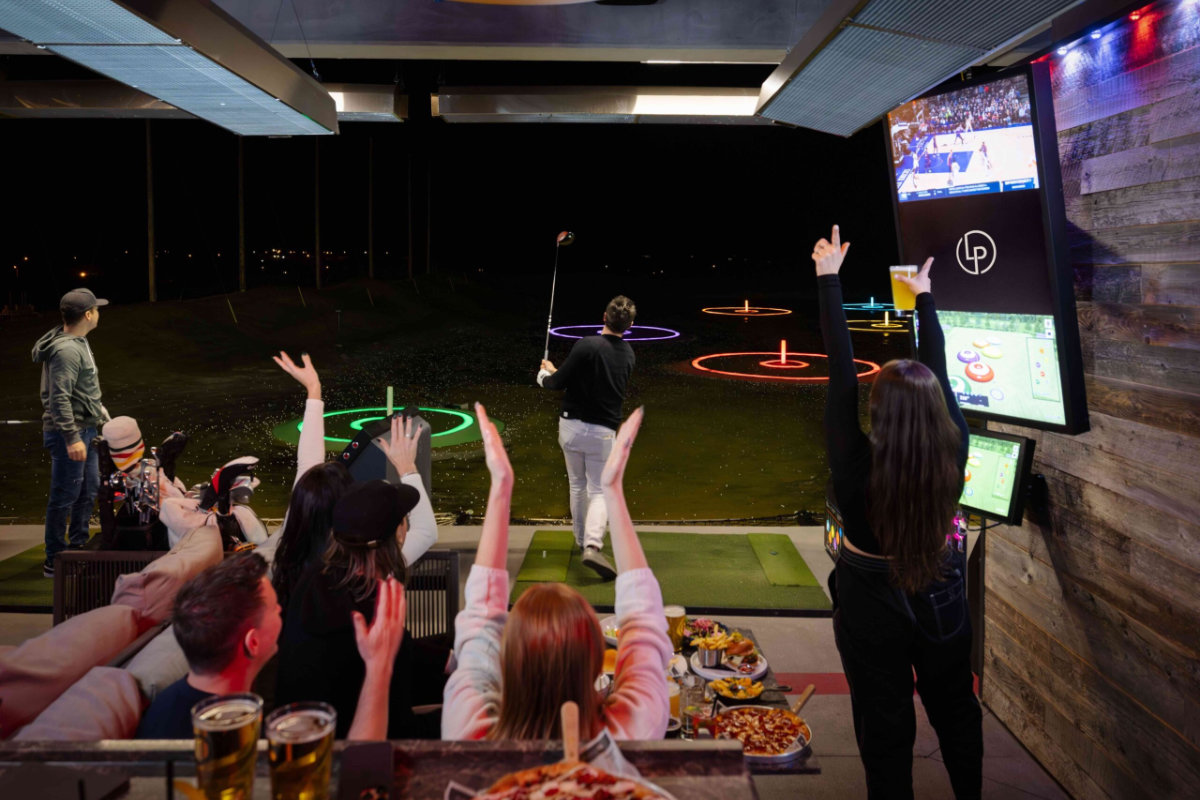
Unlike traditional retail, which is often transaction-driven, entertainment golf is built around duration and engagement, converting a single visit into multiple revenue streams. The model inherently complements food and beverage, creating consistent, high-margin spend throughout the customer experience.
PopStroke
Mini-golf concepts like PopStroke, which combines professionally designed putting courses with bars, a kids’ playground, an ice cream parlor, TVs, and backyard games, have capitalized on the retail opportunity that entertainment golf brings.

For instance, groups of friends can spend an entire afternoon or evening at PopStroke, playing a round, ordering drinks directly from their mobile app while on the course, and sticking around afterward for games like cornhole, foosball, and ping pong.
The result is a highly social, all-in-one experience that consistently drives elevated food and beverage spend. Families are equally drawn in, with kids entertained by the course, playground, and ice cream, extending visit duration and increasing total spend per group. For those who are more serious about golf, the professionally designed putting course mimics real-world conditions, allowing them to work on their skill set in a relaxed and social setting.
PopStroke is just one of many places that are adding retail to enhance the guest experience.
LaunchPad
Similarly, LaunchPad at The Meadows in Prior Lake demonstrates how these concepts can expand beyond core golf users. By pairing entertainment golf with a full-service, chef-driven restaurant, the venue attracts a broader demographic, many of whom are drawn as much by the social and dining experience as the golf itself, broadening the customer base beyond traditional golf users.

Because these concepts keep guests onsite for 2 to 4+ hours, retail opportunities thrive, translating to higher spend across food, beverage, merchandise, and adjacent games and arcades.
Bringing New Players to the Game
Beyond its impact on retail environments, entertainment golf is also expanding the overall player base. It has become one of the most effective entry points into the sport, attracting first-time participants while re-engaging lapsed players through a more accessible, low-pressure format.
The National Golf Foundation (NGF) reported more than 3 million beginner players have picked up the sport every year since 2020, noting that entertainment golf has become a “valuable on-ramp” for newcomers to the game.
The NGF also reported that 23% of new golfers started playing traditional golf after first playing at Topgolf.
So what does this mean for the broader retail ecosystem?
As participation expands, so does demand across the golf economy, from equipment and apparel to lessons and club fittings. Retailers such as PGA Tour Superstore, Dick’s Sporting Goods, and Golf Galaxy are scaling their footprints to capture this growth, with PGA Tour Superstore alone increasing its store count by approximately 80% since the pandemic.
More broadly, this trend reinforces a shift toward experience-driven retail, where tenant performance is increasingly driven by engagement and dwell time rather than transaction volume alone.
Implications for Owners and Developers
For retail owners and developers, the rise of entertainment golf has direct and measurable implications for site planning. In practical terms, this impacts everything from site layout and parking design to co-tenancy strategy and lease underwriting assumptions.
These concepts typically occupy large-format spaces and require significant parking, but in return, they generate extended dwell times, often 2 to 4 hours or more, and drive consistent evening and weekend traffic. This makes them particularly effective as modern anchor tenants, capable of activating surrounding retail, food and beverage, and adjacent uses.
In many markets, entertainment golf is increasingly filling the role once held by traditional junior anchors, while delivering stronger engagement and higher per-visit spend. When paired with multifamily, hospitality, or mixed-use environments, these concepts can materially enhance overall project performance and leasing velocity.
As a result, these tenants are increasingly being underwritten not just as entertainment uses, but as primary traffic drivers within retail and mixed-use developments.
Entertainment golf is no longer a complementary use, it is increasingly becoming a central component of modern retail strategy. For developers and landlords, the opportunity lies in recognizing its ability to drive traffic, extend dwell time, and enhance the performance of surrounding tenants.
As experiential retail continues to evolve, concepts that blend entertainment, food and beverage, and social interaction will play an increasingly critical role in shaping successful projects.
Share This Article


